
Fused Glass vs. Blown Glass:
What's the Difference?
If you've been shopping for handmade glass art, you've probably seen both fused glass and blown glass described as "artisan" or "one of a kind" — but the two techniques are actually quite different, from the process to the finished piece you end up with.
How Fused Glass Is Made
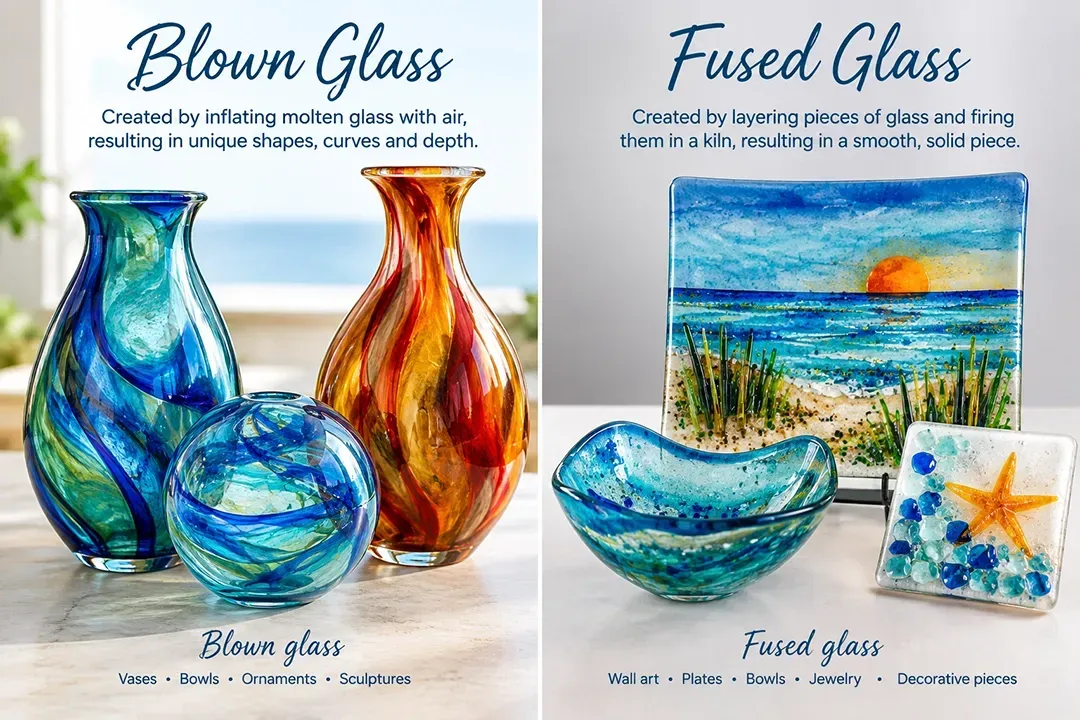
Fused glass starts flat. Sheets and pieces of colored glass are cut, layered, and arranged by hand, or add glass powder/frit to the design, then placed in a kiln and heated slowly until the layers melt together — or "fuse" — into a single piece. Depending on the design, the glass may be fired multiple times: once to fuse the layers, and again to slump it into a curved or dimensional shape, like a bowl, tray, or candleholder.
Because the process relies on careful layering and controlled kiln temperatures rather than shaping molten glass by hand in real time, fused glass tends to have a more graphic, painterly quality — bold color blocking, layered textures, and clean lines.
How Blown Glass Is Made
Blown glass is worked while molten, gathered on the end of a blowpipe and shaped using breath, gravity, and hand tools while it's still hot and workable. It's a faster, more physical process, and it's what gives blown glass its characteristic flowing curves, bubbles, and rounded forms.
Which One Is "Better"?
Neither — they're just different crafts suited to different looks. Blown glass tends to favor organic, rounded shapes (think vases and ornaments). Fused glass lends itself to flatter or slumped forms with rich color layering — trays, wall art, coastal-inspired sculptures, and pieces where color and pattern are the focus.
What This Means for You
Every fused glass piece at Glass Oasis is designed and fired by hand here in New Bern, NC — no no mass production. That means the color combinations, layering, and shape of the piece you're looking at are exactly what you'll receive. If you love the graphic, coastal-inspired look of fused glass, browse our Glass Beach Decor and Glass Home Decor collections to see the technique in action.
Glass & Painting Articles